Overview of results achieved within the NSDI for the period from January to June 2026
During the first half of 2026, activities on the establishment, maintenance, and development of the National Spatial Data Infrastructure (NSDI) continued. The activities were aimed at the inclusion of subjects and spatial data sources into the NSDI, the enhancement of the NSDI Registers, the NSDI Geoportal and GeoHrvatska, user education, monitoring the implementation and revision of the INSPIRE Directive, as well as the identification and analysis of spatial high-value datasets.The development of the NSDI is evident in the continuous growth of the NSDI Registers. Since the beginning of the year, the number of registered subjects increased from 296 to 311, while the number of recorded spatial data sources increased from 1577 to 1687, where the number of datasets and series increased to 1038, and the number of network services reached 649.
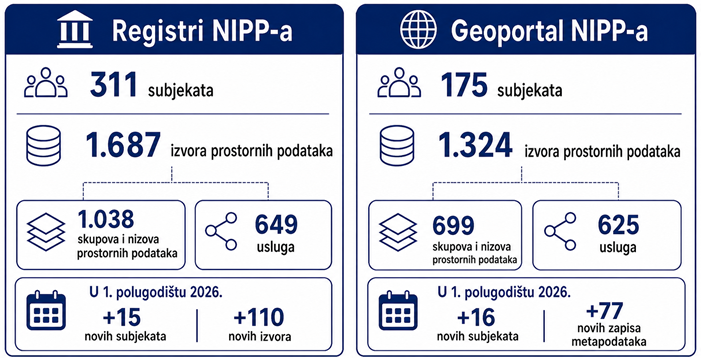
The readiness of spatial data for further interoperable use is best reflected on the NSDI Geoportal, the central place for accessing spatial data in the Republic of Croatia. A total of 175 subjects are recorded, 16 of which are new, along with 1324 spatial data sources, 77 of which are new. Among the new sources, there are 52 new datasets and series, adding up to 699 in total and 25 new services, reaching a total of 625 by the middle of the year.
In addition to the activities related to the Registers, NSDI Geoportal and GeoHrvatska, the following results were reached during the first half of the year:
- Three NSDI workshops were held, two of which were practical, intended for representatives of local self-government units, focusing on entering metadata into the NSDI Geoportal. As part of the SDI Days 2026 conference, the 46th NSDI workshop titled "High-Value Datasets in the NSDI" was held, addressing the legal framework, availability, publication, and reuse of high-value data, as well as the connectivity of relevant data portals,
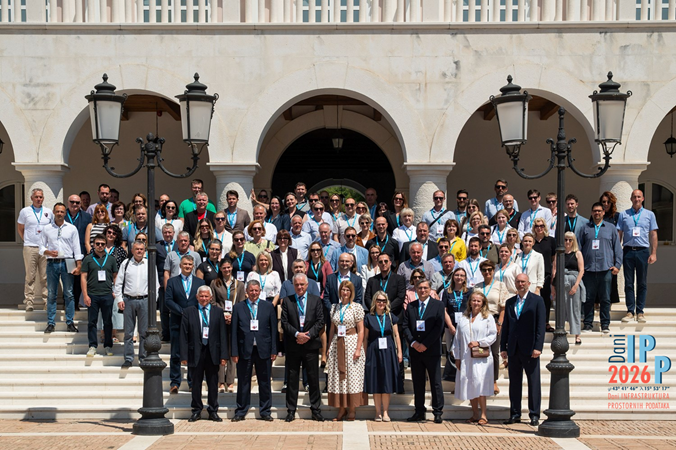
- On May 28, 2026 in Šibenik, the conference Spatial Data Infrastructure Days 2026 was held, gathering around 120 participants. It featured the 46th NSDI workshop and the 15th NSDI and INSPIRE day with an invited lecture, panel discussion and expert sessions,
- The Working Group for High-Value Datasets in the NSDI was established and the first meeting was held, after which activities for recording and analyzing the availability of spatial high-value datasets commenced,
- Employees from the National Contact Point for NSDI and INSPIRE actively participated in preparing the Republic of Croatia's framework position paper and providing expert opinions during the revision process of the INSPIRE Directive,
- The 14th session of the 7th convocation of the NSDI Council was held, adopting the new Rules of Procedure for the Council and presenting the NSDI Activity Report for 2025, which was subsequently accepted by the Government of the Republic of Croatia,
- The results of the annual monitoring of the INSPIRE Directive implementation for the Republic of Croatia have been published, demonstrating the continuation of a high level of implementation across key areas,
- The spatial data of NSDI subjects displayed in the GeoHrvatska browser and mobile app was updated, with simultaneous upgrades to existing functionalities of the system, with the aim of advancing the user experience and creating a more efficient and intuitive interaction for the user with the system,
- Regarding user access, the NSDI Geoportal recorder 16.000 visits, while 13.000 users accessed GeoHrvatska. The GeoHrvatska mobile application was downloaded 45.090 times.